Research
Two instruments. Three pages. Jamie Index Substack editions below.
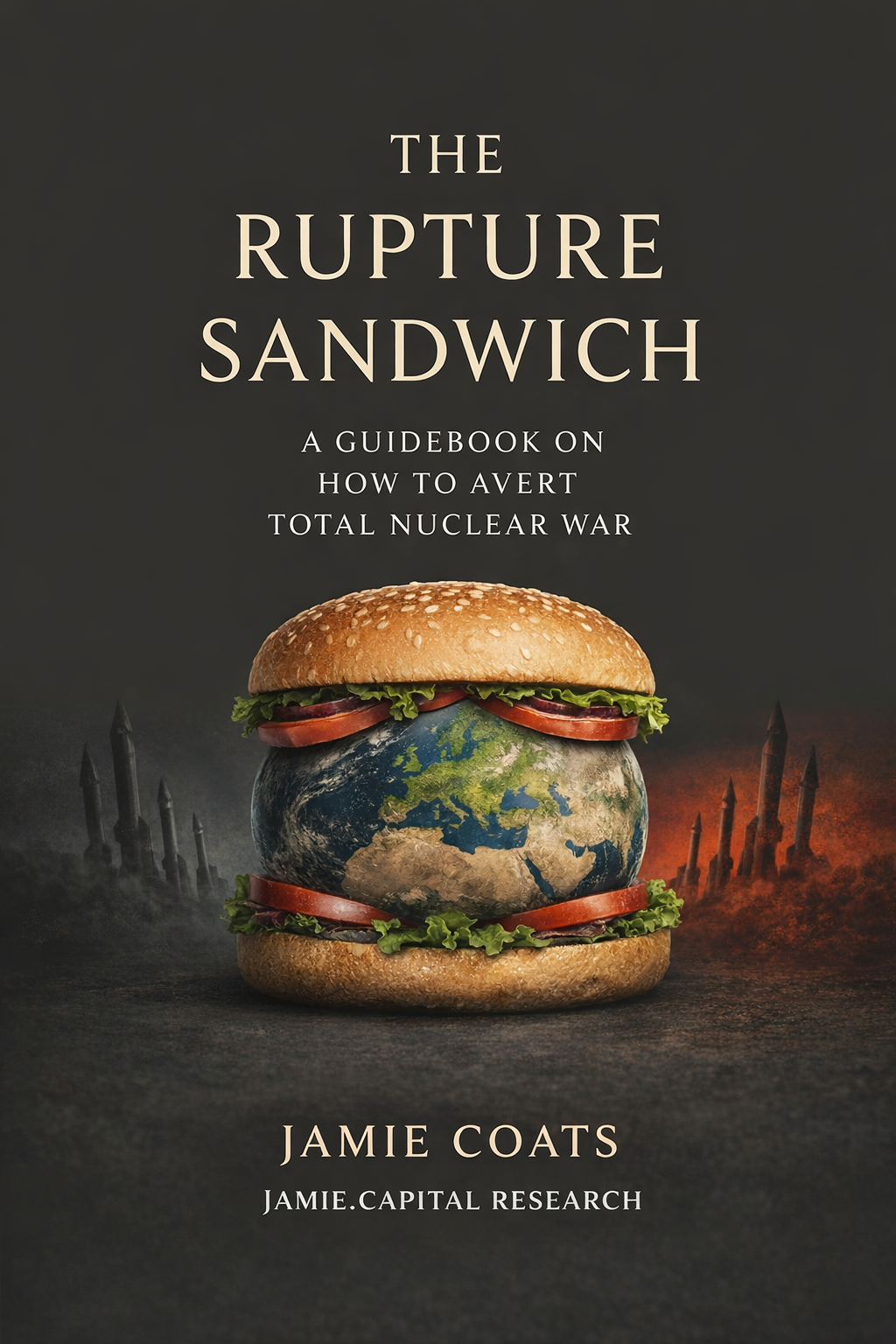
“Jamie Coats outlines a chilling scenario ahead based on a model that tracks rising risks of U.S. civil war and a nuclear attack by Russia. You may not agree with every assumption or every risk score, but the transparency of the methodology means you have to explain to yourself where you diverge and why. The book, which incorporates the most recent headlines from Iran, also offers useful markers for interpreting the confusing blizzard of daily news. Most important, it offers advice to investors, public officials and citizens on how to manage these dire risks, and, more importantly, what each of us can do to help turn the course of events in a better direction.”
The Arbroathgroup — Geopolitics & Macroeconomics, Strategy & Insight · Boston, USA
Jamie.Capital Research publishes work on two distinct quantitative instruments — and this page is one of three references for them.
JI The Jamie Index measures the conditional probability of a US–Russia crisis (0–100 composite, 25 indicators, monthly editions). CWNS The Civil War Net Score measures structural proximity to civil conflict (0–7 scale, 8 variables, calibrated against four centuries of English-speaking civil-conflict history). Each has its own framework page; this page lists the Jamie Index Substack editions.
The Jamie Index is a 0–100 composite of Marker II (US institutional fracture, 60%) and Marker III (Russian opportunism, 40%). Monthly editions published on Substack. Full methodology in the Jamie Index Framework.
The Jamie Index rises to 88 — a fifth consecutive Critical reading. A US threat to cut intelligence sharing with Ukraine and a US–Russia diesel deal that divides the alliance move Marker III; Marker II holds at 97. Full current reading on the site.
The Jamie Index rises to 87 — a fourth consecutive Critical reading. A federal ruling sends a Marker II indicator to its ceiling; a Russian ICBM test and a wave of diplomatic ruptures with Europe move Marker III.
The Jamie Index rises to 85 — a third consecutive Critical reading. China's restraint on Moscow weakens; the US–Russia diplomatic channel partly reopens; nine of twelve Marker II indicators reach their ceiling. Full current reading on the site.
Russian nuclear talk drew Beijing's first ultimatum to Moscow. The brake slowed the climb — the Jamie Index still rose to 83, on fracture in the USA.
The Jamie Index enters the Critical band at 82 — America fractured at home and abroad at once, and Russia pressed into the opening.
The Jamie Index reaches 78 — two points below the Critical threshold. High Alert band holds.
Army Chief fired mid-war. Trump posts threat to destroy Iranian civilian infrastructure. DoD Law of War Manual creates explicit obligation to disobey illegal orders. MII jumps to 84. P(Crisis) reaches 47%. Critical band entry: August 2026 baseline.
War powers vote failure. Russia-Iran alliance confirmed. Opportunism Window scores 5/5 for the first time. P(Crisis) reaches 43%.
War powers rupture. Russia false-flag warning at Zaporizhzhia. Post-inauguration escalation rate rises to 1.86 pts/month.
Formal establishment of the Jamie Index. Full backtest April 2024 to January 2026, methodology, and opening trajectory projections.
Why two years were spent building a geopolitical crisis index — and why the first reading matters.
Between the monthly editions, the Jamie Index publishes shorter pieces on single questions — a named argument, a document, or a figure worth following. Published on Substack alongside the editions.
In 1973 the USA faced down Moscow while its President slept. If President Trump is impeached, who will hold the line against Russia?
At the United Nations: a knotted pistol, a message from The Elders, and a USA that has stopped quarrelling with itself. What loads the chamber?
Answering critics of the previous piece by testing who is actually behaving irrationally around an unfunded war — Trump, Congressional Republicans, Iran, Russia, or the WSJ editorial board — and finding the 1640 parallel holds.
Congress's refusal to fund the administration's immigration-enforcement agenda through the stopgap spending bill tracks the same funding standoff that opened England's constitutional crisis in 1640.
Charles I's 1642 declaration of war on Parliament, read against a week of escalating confrontations between the administration and Canada, economists, and military officials.
Engagement, pressure — and a third camp nobody names. Who actually shapes Russia policy in Washington, and which of the three readings the evidence supports.
Sweden is building its own MI6. Jeffrey Sachs says Russia will never attack Europe. Britain's spy chiefs say it already is. The answer runs through what each camp counts as evidence.
Jamie Dimon will not buy the long end of his own government's bond market. What the most-quoted commentator in the framework is now saying about American fiscal and institutional solidity.
The critical calibration reference is the Cuban Missile Crisis: Black Saturday, October 1962, scored 32 on the composite Jamie Index. Full calibration methodology in the Jamie Index Framework.
The closest the world came to nuclear war in the twentieth century scored 32 on the composite Jamie Index. The current reading of 71 is more than double — not because Russian aggression exceeds 1962 levels, but because the institutional architecture that resolved the CMC can no longer be assumed.
PublishedWolf's correction of Krugman: not 1688 but 1641. Establishes the six-stage Charles I pattern and maps it onto the Trump/USA 2026 sequence.
PublishedThe English Civil War was overlaid with religious conflict. The contemporary woke/unwoke divide as its structural analogue. Money can be divided; doctrine cannot.
PublishedGold has overtaken US Treasuries in global reserves — but not the dollar. What the reserve-asset shift signals for the structural picture.
PublishedWhat El-Erian and Dimon's October 2024 comments reveal about where institutional risk thinking was heading — and what a Jamie Index at 71 implies for gold's next move.
PublishedNew research is published to subscribers first. Subscribe to receive each edition on publication.
Subscribe at jamieindex.substack.com →