The Jamie Index
The index sits at 88 — a fifth consecutive reading in the CRITICAL band (81–100). The conditional probability of a US–Russia crisis stands at 66%.
This month the movement came from inside the alliance. Marker III rose three points to 75: the USA threatened to cut off intelligence sharing with Ukraine, which then received no early warning of Russian missile strikes two nights running; and a US deal with Moscow on Russian diesel opened a public divide with European allies over sanctions. Marker II — US fracture — held at 97, with most of its twelve indicators at their ceiling.
The Civil War Net Score held at 6/7 for a sixth consecutive edition: its two US-fracture variables are already at their ceiling, and the one moderator that has not broken is the cohesion of the military.
These three predictions were written in March 2024 — before a single vote was cast. They are not commentary. They are a causal architecture: each marker unlocks the next.
Marker One was the precondition. Without a Trump presidency, the chain does not activate. It was confirmed on 5 November 2024.
Marker Two is the mechanism. A fractured military and intelligence apparatus does two things at once: it degrades America's capacity to respond to a crisis, and it signals to adversaries that the window is open. It now stands at 97 out of 100 — with most of its twelve indicators at their ceiling.
Marker Three is the consequence. Russia does not need to manufacture a crisis — it only needs to read the fracture correctly and calculate that the cost of acting is lower than at any point since 1962. That calculation is already underway.
The Cuban Missile Crisis resolved because Marker Two was effectively zero. Kennedy had complete institutional unity. That architecture no longer exists.
A quantitative instrument measuring the structural pre-conditions for civil war in the United States. The CWNS registers 6 out of 7 — published Final is cap-bound at 6 because Military Violence holds below 5 (ADR 0002). This edition the Raw held at 38 and the Final held at 6/7 — the cap continues to bind because Military Violence stays below 5. The Jamie Index rose again this edition on strains inside the Atlantic alliance; the civil-war reading held at 6/7 for a sixth consecutive edition, restrained by the one moderator that has not broken: the cohesion of the military.
Built independently from the Jamie Index and calibrated against a four-hundred-year historical record, the CWNS corroborates the existing Jamie Index trajectory. Both instruments project to reach their respective maximums within the same calendar window: the Rupture Window of March 2027 to Q4 2027.
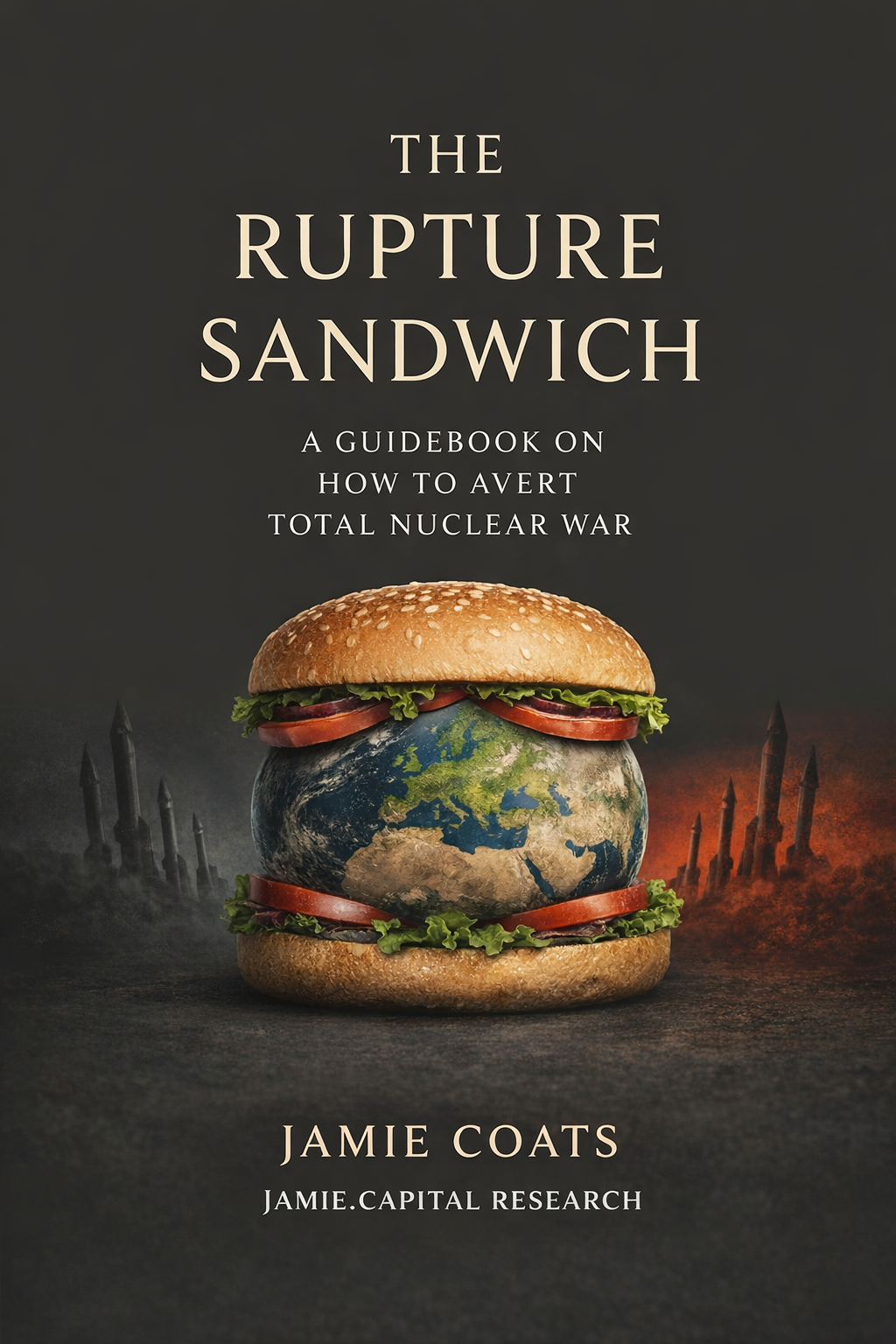
“Jamie Coats outlines a chilling scenario ahead based on a model that tracks rising risks of U.S. civil war and a nuclear attack by Russia. You may not agree with every assumption or every risk score, but the transparency of the methodology means you have to explain to yourself where you diverge and why. The book, which incorporates the most recent headlines from Iran, also offers useful markers for interpreting the confusing blizzard of daily news. Most important, it offers advice to investors, public officials and citizens on how to manage these dire risks, and, more importantly, what each of us can do to help turn the course of events in a better direction.”
The Arbroathgroup — Geopolitics & Macroeconomics, Strategy & Insight · Boston, USA
"An early-warning system — identifying inflection points before they become visible in conventional analysis."
"For those of us responsible for allocating capital, managing risk, or shaping strategy, that is where the value lies: not in certainty, but in sharpening awareness, reducing the risk of surprise."
Monthly editions delivered directly to you. The index score, the trajectory analysis, and what it means for the decisions you are making.
Band & probability
Brief commentary
Three scenario projections
Investment signal